Research · Pulse
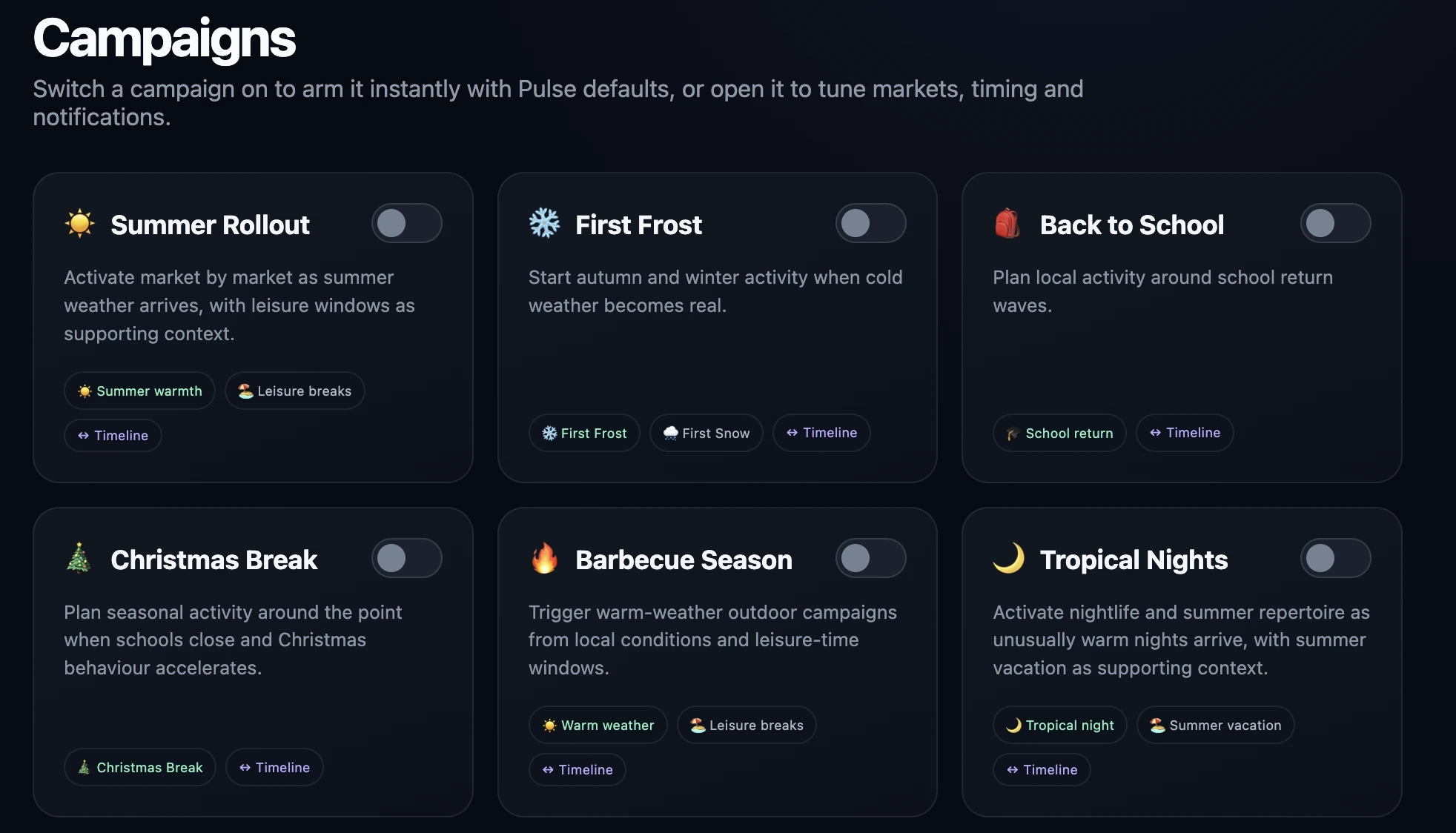
Christmas: when should your campaign start?
Prepare in October, then use local signals to decide when to activate and scale. A practical seasonal campaign framework for Pulse.
Read the guide →
The knowledge hub
Explore the ideas, evidence and practical workflows behind the Catalyse ecosystem.
Research · Pulse
Prepare in October, then use local signals to decide when to activate and scale. A practical seasonal campaign framework for Pulse.
Read the guide →Tutorial · Analytics
A short framework for deciding what to analyse, what matters and what to do next.
Read the guide →Tutorial · Trace
How to interpret audio findings without turning a signal into a claim of certainty.
Read on Trace →Tutorial · Pulse
A practical starting point for connecting calendar, weather, culture and sports to your audience.
Read the guide →Research · Trace
One detector flags your track. Another clears it. Compare the evidence, workflow and privacy questions that matter before choosing an AI music detection tool.
Read on Trace →Research · Trace
Compare free scans, upload limits and report features from TRACE, Authio and The Ghost Production—and learn what their detection scores can tell you.
Read on Trace →Research · Trace
Some processing can weaken detection in specific systems. That is not a universal watermark-removal recipe—or proof that a track is human-made.
Read on Trace →Research · Trace
Adding human instruments changes a mix—not its history. Learn why audible masking, watermark detection and AI audio evidence are different questions.
Read on Trace →Research · Trace
An inserted watermark and a forensic audio finding are different clues. Neither a missing marker nor a reassuring scan establishes human authorship.
Read on Trace →Research · Trace
A flagged region is a reason to look closer. Here’s how to read an AI music scan without turning an indicator into a verdict.
Read on Trace →Research · Trace
Save the sources, versions and production notes that explain your track. An AI music scan cannot reconstruct the creative process for you.
Read on Trace →Research · Trace
A generated vocal over human instrumentation raises a different question from an entirely generated song. A master-level label cannot describe every contribution.
Read on Trace →Research · Trace
A changed scan after mastering does not explain how the music was created. Keep the versions and investigate the reported evidence in context.
Read on Trace →Research · Trace
A different export is a different input. Here is how to interpret a changed scan without treating compression as proof of a track’s origin.
Read on Trace →Research · Trace
Separate tracks can add context, but separating a master does not automatically prove where a suspicious signal originated.
Read on Trace →Research · Trace
Two scans can give different answers for the same track. Understand what that disagreement tells you before treating either result as a verdict.
Read on Trace →Research · Trace
Format, file structure and provenance clues can add context to an audio scan. Missing metadata is not evidence of human authorship.
Read on Trace →Research · Trace
That percentage describes flagged time across your track. It doesn’t measure how much of the music was made with AI.
Read on Trace →No published content in this category yet.
Research and tutorials across Catalyse are managed in one editorial workspace. Each article links to its published home.
Explore Trace ResearchCatalyse on YouTube
Visit our channel for Catalyse videos. Video tutorials will appear here alongside their written guides.